Friday, May 20, 2011
Discourse: Daisy, Rosie, and Her Mother
Wednesday, April 20, 2011
Discourse -- Lucifer: Exodus, Volume 7 by Mike Carey
1). Mazikeen is awesome.
2). Elaine is awesome.
So now that Heaven is up for grabs, basically, some titans think they can just go out and claim it. Then Lucifer goes Doctor-Who on them as he defeats them in a timey-wimey fashion.
But forget that. Let's talk about how Mazikeen strides into heaven, doesn't give a single fuck that she's not wanted there, in order to warn Lucifer and foil their plans. See, the titans had created a Bizzarro-Lucifer from the memories of a waitress who used to work at Lux. So Mazikeen drags the waitress, works some magic, and voila! good guys win the day and then the angelic host is all grumpy because demons are bad and god forbid they be sullied with the presence of the likes of Mazikeen, right?
Behold the power of lesbian-love:

Oh. Beautiful.
And as for Elaine -- check this out:
She became a guardian to Lucifer's world in the last volume, but she was still in her little-girl school clothes. But now now she's grown up and her clothing changes to reflect that.
I find this absolutely refreshing in a society that infantalizes women. And, of course, the clothes continue to symbolize her Grown-upness -- there's a scene towards the end where she's disappointed with herself and angry at the job she had to do and she reverts to her school-girl uniform and then reverts back when Mazikeen tells her she's acting like a child.
Cool stuff.
But, I think the most poignant story of this volume was the one about Thole and Martin.
It was like a dark version of Dr. Seuss.
The story was wonderful -- playing with themes like love and self-hood:
I like this because it touches on a common theme in speculative fiction -- ideas of perception and selfhood. Are we humans entirely sure that the beings we mindlessly other are not individuals too, granted with "personhood" as well?
But the theme isn't hammered over the reader's head -- it's just there, in all it's simplicity.
I like this because it recognizes what a complicated emotion love is. Sometimes I feel that it's always so simplified in a lot of stories.
Awwww.
I adore this image. Anyway, upshot is, Thole ends up attracting himself a mate and, in the fashion of black widows, she is a bitch from hell. Of course, Martin feels rejected and, in a fit of pique and jealousy, throws away the self-stone Thole had made him.
I found the gesture to be an incredible metaphor. How many times do we everyday people just throw ourselves to the mercy of our emotions -- allow ourselves to surrender to some of our darker impulses? And I couldn't help but wonder that, somewhere when that happens, when we become villains in our own stories, that we are throwing away our selves in anger or pain or grief.
I love the background -- the fragments of faces, of identity.
Poignant. Beautiful.
Another moment of Elaine-Awesomeness:
Whereas Mazikeen fulfills the imperative of Lucifer to get rid of all the immortals in his universe with the sword, Elaine does so with the mind.
And she takes away Thole's immortality:
I may have gotten teary eyed at this point in the story:
Martin is obviously more adjusted than me. I think that Death would have been proud of him.
On a happier note: Mazikeen looking sexy and awesome as all hell
Discourse - Lucifer: Mansions of the Silence Volume 6 by Mike Carey
And then wham.
Surprise visit of Holy-Shit-They-Actually-Went-There.
Yes. That is a literary term.
Meet Jill Presto:
mother to be of a magical baby because the tarot people raped her and impregnated her with it. Throughout the course of the story, the boy has become corporeal and is trying to cozy up to mother dearest, declaring his love for her and trying to convince her that she must love him too:

Then he becomes injured in the course of the story as he steps in to protect his vessel/mother.
And she does make her decision:
Please, Jill. Tell us how you /really/ feel. This is where I first began to stagger. I mean, you just don't see mothers acting like this in a lot of pop cultury things. I mean, even Gabriel still loved her demon spawn from Xena: Warrior Princess.
But then this took the cake:
Excuse me while I have a holy-shit moment.
Perhaps this doesn't seem so significant if viewed in a bubble -- but consider:
Take Fringe for example. Where "abortion" is never even mentioned as an option (even when it's later revealed that the pregnancy would probably kill both mother and child).
Then there's another show called Invasion -- it's about aliens, but what's the first symptom that aliens have been fiddling with the humans? When women stop acting like mothers. So -- you have a mother abandoning her kid (side character played by the chick that plays Peggy on Mad Men, btw). Then you have another primary character who's a doctor. She doesn't seem to be Off because she stops being such a good job. Oh no. Something's wrong because she stops being a good mom. She doesn't call her kids and tell them that she's going to be late after a big ass hurricane.
It's the Monstrous Mothers trope -- women so far perverted that they reject the very fiber of their being -- their motherhood -- and thus become irredeemable monsters.
And here this is being subverted in a glorious fashion.
Jill doesn't want to be a mother. She wants to have a career and have good sex. She is furious when someone tries to tell/force her that she needs to love this child. I really appreciate how they position love as a choice, as an action springing forth from someone's agency, instead of something natural.
It's self-validating. Individuality first, role second.
But the volume wasn't just about motherhood -- it was about fatherhood too. Because God the Father is abandoning the Silver City and randomness/chaos is about to ensue. Gabriel feels betrayed, Lucifer is hardly surprised. Though perhaps my favorite line so far in regards to Lucifer and God the Father is this:
FOR YOU ARE THE KING OF CONTRIVANCE AND MANIPULATION, MY SAMAEL, BUT IN THAT, AS IN ALL THINGS -- YOU LEARNED FROM YOUR FATHER.
Slytherins! The lot of them. And I fucking love it. I'm hoping the fatherhood theme will play out more in further episodes, but I just find the juxtaposition of a masculine character and a feminine character abandoning certain roles society has thrust upon them to be fascinating.
And, of course, I like the subversion of the typical concept of God so prevalent in Judeo-Christian societies. I mean, I don't think that "contrivance" and "manipulations" would be the first adjectives the average person would use to describe "god."
Saturday, April 16, 2011
Discourse - Lucifer Volume 5: Inferno
I guess I got the feeling that this text was all about setting pieces in order for more substantial character arts and Awesome Happenings -- which is totally okay. Set-up whets the appetite for more. If every minute of everything was awesome, then there would not be an awesome.
I wasn't really expecting Mazikeen's husband to show up. That was an interesting story-line -- I like how she defeated him, how because she was a woman, nobody taught her, nobody expected her to learn -- but she did. Empowering.
I also liked the character Lys. She's been infected with humanity, she's scrabbling for her father's authority. All good stuff. Looking forward to see what'll happen next with her.
I think when one of the most tender moments was when Duma came to Lucifer's aid. There is so little compassion -- true compassion -- like that left in the world. I find it utterly beautiful wherever I see it. And when he tells Lucifer that three have defied God's will -- he looks so sad.
Speaking of compassion -- there was an odd little arc about Miss Zim'et and Sabah. There is this trope that the Big Bad is always going to want human life, babies, or some virgin -- but they wanted Sabah's tumor, thus saving his life. I wasn't really expecting that, and I thought it hinted at an interesting direction. I hope to see more of where this leads.
I guess the most surprising character was Solomon -- I wasn't really expecting him to show up. I'm glad that they kind of commentaried on that blind fanatacism, forcing them to question whether they truly are doing God's will, even if they think they are.
Good stuff.
Wednesday, April 6, 2011
Discourse - Lucifer Volume 4: The Divine Comedy
Lucifer as Anti-hero, Lucifer as Character
This text introduced an interesting juxtaposition of Lucifer.
First, it begins with Lucifer revealing himself to the citizens of his newly populated world. He towers above them, a figure of strength, and a taker of no bullshit.
His first command is the forbidden commandment of worship.
This is, inherently, an image of strength. Lucifer is beautiful in his rebellion, in his absolute self assuredness, in his confidence, and, most importantly, in himself.
However, as the draws towards its end, that strength is undercut with a newly revealed aspect of his character.
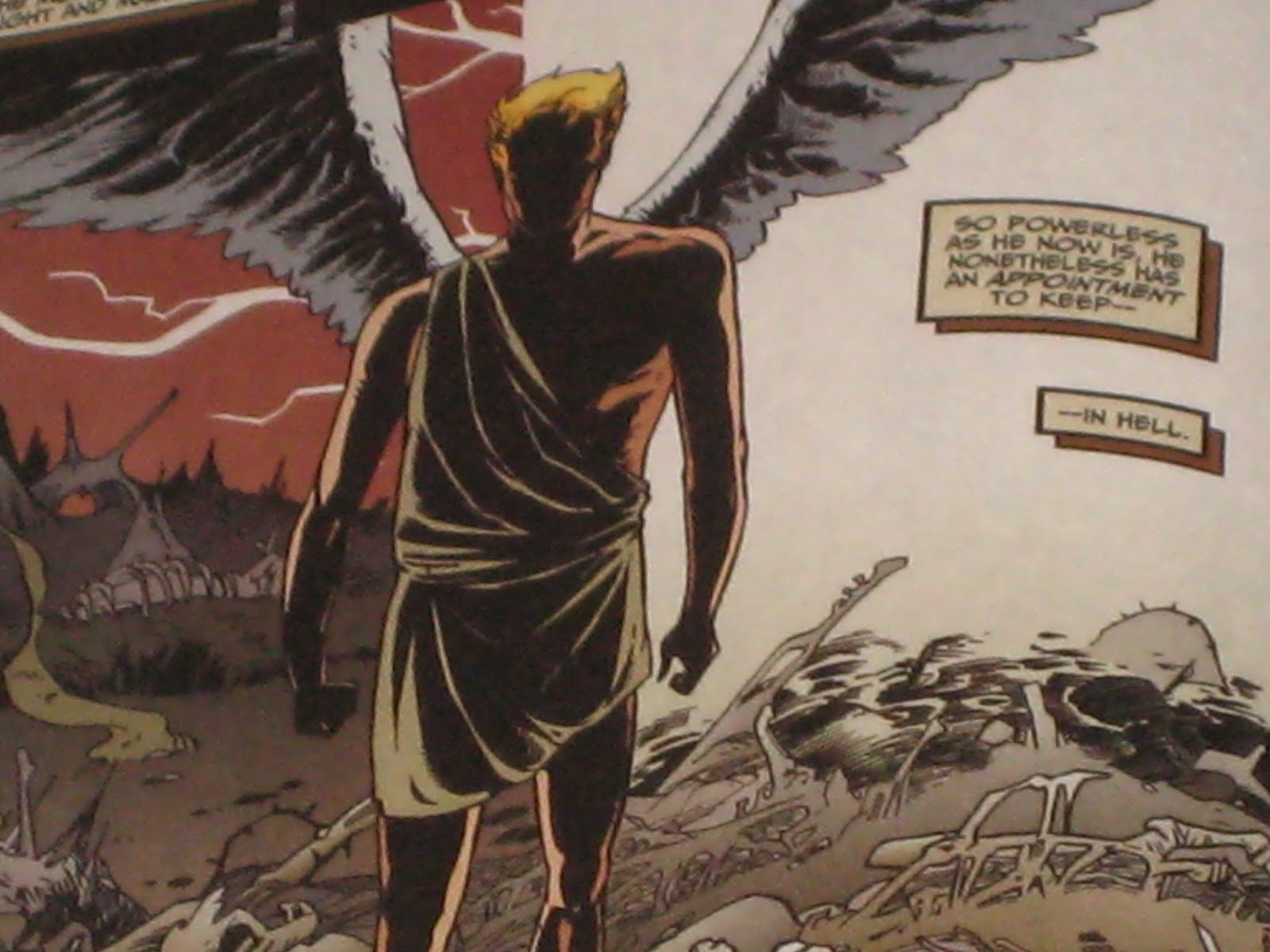
It's not when he falls when the Cards attempt to establish themselves as gods in his universe. It's not when he falls prey to a magical attack from behind (a plot point simmering since volume 2), it's not even when he goes forward into hell to face the angel completely powerless (which is, ironically, an image of strength in and of itself).
It's when he converses with Death that he reveals the fragility of his character, of his inexorable will.
He does not accept death, he flings himself against her in anger and denial - and she cooly, confidently gives him a piece of her mind and advice while she's at it.
The differences between their manners is staggering -- and it adds more depth to an already complex character.
I think that's one of the reasons I love this image so much:

It incapsulates the very nature of their conversation.
And it is beautiful.
As for the anti-hero - Lucifer knows how Elaine adores him. How she loves him. How she'd do anything, absolutely anything. How young she is.
And he does not warn her that in giving life to him, she will sacrifice it for herself.
That moment is so poignantly sad.
I love how Carey isn't afraid to make it absolutely real.
Lucifer, Michael, and Yahweh
I liked how Lucifer and Michael became two sides of the same coin essentially. Lucifer is full of this inexorable will, Michael full of creative power. Without them both, the new universe would never have come to be.
They are, in a way, a circle, incomplete without the other. And this is seen even more clearly in Michael's fall.
I'm eager to see how volumes 5 and onwards will explore this circle that's sort of coming into light. And, of course, I could be misreading it, but I hope I'm not.
I love how offended Lucifer was when Death compared him to Yahweh -- even as he conveniently ignores all their other similarities: creation (the big bang encore), a first people, appearing on high and delivering a commandment - simply differing on the nature of the commandment.
It's interesting that in this and other literature about the devil, folks have always commented on Lucifer's pride, the pride that eventually lead to his downfall.
Yet, he commands people not to worship anybody -- not even him.
And, on the contrary, the god of the Bible is a jealous god, demanding the sole worship of himself.
It's just interesting, the juxtaposition of the two characters in parallel with each other.
I also liked the subtle (and not so subtle) commentary on religion. Lucifer's world was perfectly happy and content without religion -- they were beautiful and intelligent, so much so that Rachel slips into that universe with wonder and amazement.
This world - torn apart by war and there are still nations living impoverished and uneducated.
And it's only when the Cards come claiming to be gods that true, national disaster strikes.
My atheist heart thrilled.
Monday, April 4, 2011
Discourse - Lucifer Volume 3: Dalliance With The Damned

Unfortunately, this is going to be less a review and more of a highlights. So, without further adieu (since I still have Volume 4 to read and it's due back at the library tomorrow):
Lucifer as God; Angels as Demons
Still enjoying the inversion that's going on here. Lucifer makes his realm and his only command is
Bow down to no one. Worship no one. Not even me. Do you understand?
So beautiful.
And then of course one of the angels comes to the man in the form of a serpent, inspiring doubt in the man's (the man's! gender-bender) about Lucifer's role as creator as well, the paradox (so popular in Christian mythology) of freedom in slavery to a deity, polarizing opinions of good and evil, the philosophy that the end (or, in his words, the intent) justifies the means, the nature of desire, and other things of a philosophical nature that I wish I had the time to more thoroughly think about.
Still. Gender-bendery goodness, nature of good and evil, all good stuff.
Mazikeen
Yesterday, I enthused how Mazikeen didn't tie herself down to Lucifer and how she went off on a journey and how I still liked it, regardless of how much the reader saw of her journey or not.
Well. I'm here to tell you that Mazikeen's journey was bad ass.
She goes to find her identity, and is instead elected leader of the Lilim after she outwits her trial (since her fellows thought she had betrayed them by staying with Lucifer).
And when in hell, someone introduces her as Lucifer's consort? Oh no. She's having none of that.
Also, I really love how she refused to play act by costuming to the period that Hell had set as its desktop.
I also think I want her t-shirt: normal consciousness will be resumed.
I think I know my next Halloween costume. Oh yes.
So, in volume 2 she left to find her face -- a quest for identity. And then she found her identity in a role of leader of the Lilim. And when Lucifer refused to ally himself with them -- she didn't stay again. She left with her people. I think that's so great.
And you know what's also great? That Lucifer isn't threatened by her not staying with him all the damn time.
Pain As A Drug
One of the things I've learned in my writing class is that people -- and especially writers -- thrive off the misfortune of others. We love to gossip about it. Etc.
I've often thought about this -- noticing the little ways I myself take pleasure in the pain or discomfit of others (I can only speak for myself, but I think every individual has their own private bit of themselves that enjoys the non-happiness of others in their own unique way).
And that was illustrated (heh, pun) here, with the pain powder that was...orgasmic. But it was orgasmic because it wasn't true pain, not like he later describes:
One of the nobility of hell has picked me out to be her toy. Compared to you I am happy indeed. But somehow it rings like false coin. Do you remember the first lad or lass you loved? When you felt your chest was too narrow to hold your heart? When it seemed the world was made anew by your passion? And do you remember the fear that comes with love? The fear that it cannot last? The fear that you cannot be worthy of it? Truly we were not. none of us. But did it not come anyway? How we have poured our souls into another's lips and eyes. How we have died and been born again in the ebb and flow of their breath. All gone. The flesh you loved is dust. The words you whispered stir no echoes. And it may e that the one you loved most dearly sits at supper now with angels, and has forgotten your name. They think they mortify us with whips and wheels. But then, they have neither lived, nor loved. In truth -- they know nothing of pain at all.
I found that an interesting concept.
Lucifer as Anti-hero
There's this problem, see, with anti-heroes in stories. Anti-heroes walk a fine line. They can't be too base because then they'd make poor protagonists and then nobody would like them anymore.
Sometimes writers try to avoid this by defanging or declawing them, as it were. Spike sort of went through something similar (unfortunately).
It's difficult because you don't want them to stagnate and be boring, but they can't really be someone whom they're not at the same time (I fancy all characters have this problem, it's just really obvious and more noticeable with anti-heroes in my experience).
So, there are these two scenes where Lucifer is a magnificent anti-hero -- and the writers could have shied away and had him done something more palatable.
But they didn't.
First, he gives a demon a soul. I mean that's just. Wow, that's just cruel. And I'm in awe of it and yet, at the same time, that's...cruel (well, I suppose one doesn't become lord of hell for nothing). But yet - it's a testament to the multi-facetedness of the character.
The second bit was when some kids snuck into his house -- and prayed to God. Of course, he wouldn't save them for that. It reminded me of those people who are like -- and thank god my loved one survived this terrible accident when, in reality, it was because someone was a damned good doctor who gave a shit about his job.
So I really enjoyed that scene as a writer -- because Lucifer's still an anti-hero here instead of bowing out and taking the noble option -- and as a person who is appreciative of social commentary, wherever it can be found.
Sunday, April 3, 2011
Discourse - Lucifer Volume 2: Children and Monsters

I really liked this one, especially in light of traditional Christian portrayal of Lucifer.
For example, it's continuously stated throughout the text that Lucifer is too proud to lie, which is in direct opposition to texts like Paradise Lost that portray Lucifer as the great deceiver (I really want to write about that but I'm afraid it's going to have to wait, cry cry cry).
My rebellious, atheistic spirit also appreciated the parallel of Lucifer to Christ: three days in "hell" -- with a kind of resurrection. I think it's good to have antagonistic characters like Lucifer - it keeps people on our toes about what we think of as good and evil.
I also enjoyed the portrayal of the angels as major assholes without a care who gets caught in the crossfire in their desire to eradicate Lucifer and expand the domain of heaven (wow, sounds almost human). In fact, one of the characters even calls them "scumbags." Again, I think this challenge of what people typically consider good is an excellent way to keep people examining their value systems.
(I wouldn't be even slightly surprised if Eric Kripke admitted he slept with both Sandman and Lucifer under his pillow.)
Finally, even though she wasn't a really player in this volume, I really appreciated the character Mazikeen. Throughout the books, she's constantly shown with a mask over her face (I don't remember if the reader ever saw her without the mask in the Sandman volumes or not), and finally, in this Lucifer volume, the reader gets to see how the other half of her face looks like.
Well, throughout the course of the action, a well-meaning character manages to heal her entirely -- in other words, her face is now completely healed.
In fact, she is beautiful.
But it isn't her face, and Mazikeen is very resentful of that someone took it from her.
I really like this on several levels.
One, her identity is not rooted in her level of attractiveness. So many times there are these stories that show women pursuing this societally constructed definition of beauty, in fact, rooting their identity in such a cause (I'm thinking of flicks like the Princess Diaries where you having the ugly duckling transformed into the beautiful swan and somehow finding herself in the journey from average jane to stunning sex-bot).
I find Mazikeen's a delightful twist on this particular trope in literature.
Two, for a long time she has served Lucifer. However, she refuses to wait for him to help her and, when he is busy with his own plots and schemes, she goes off on her own to find her face. To find her identity.
I don't know how much of her journey the reader will see, but that she just went off on her own was such a delightful and unexpected example of women going off on their own journeys. So many times, women are presented as sacrificing their own identities in order to help men along on their own coming-of-age journeys, and it was just so nice to see something different and empowering.
I am seriously crushing on Mazikeen. Not beautiful Mazikeen, but masked Mazikeen.
Just the inversion of so many tropes - so many times, masks are seen in literature as personas that hide a true identity. Yet Mazikeen uses the mask to express her identity - it is a part of her.
Yes. Much love to Mazikeen.
Thursday, March 31, 2011
Discourse: A Brief Note About Lucifer the Graphic Novel

I just finished reading Lucifer: Devil in the Gateway by Mike Carey.
This is a spin off from Neil Gaiman's amazingly epic and awesome Sandman books. And if you haven't read them, go and do so. I highly recommend it because they are beautiful and wonderful.
Unfortunately, I was an idiot and dropped off this particular graphic novel (the Lucifer one) at the library because I temporarily forgot I was blogging about the books I read. Oh well, I think the strongest story was the Six Card Spread storyline anyway.
I learned two things.
1). I should really, really educate myself regarding the Tarot
2). Lucifer is a delicious anti-hero and I would kill to see Mark Pellegrino play him in a tv series (or mini series!) based on the graphic novels.
However, there was this one particular moment in the Six Card Spread issue that was very - poignant. It was set in Germany, and one of the characters, a blond-headed boy (Karl), got himself messed up with some. Well, let's just call them Nazis, shall we? They would find people who weren't like Them and beat them up. Because they could.
Unfortunately, there's another boy who has a crush on Karl. He is not German (Indian, I believe). And he is a homosexual.
And he finally gathers the strength to ask out Karl. Who meets in an alley with his Nazi friends who commence beat the shit out of him. And do something nasty to his genitalia.
It's a very disturbing scene. More so because it happens in real life.
Anyway, Karl goes out drinking with his friends, then excuses himself to piss in order to call an ambulance. He's obviously a bit emotionally distraught and when the ambulance people are being thick, he shouts that he will show them where his victim was.
While he's waiting, he runs into his employer (who is an angel, a bookstore keeper, and distraught since Lucifer has dealt him a very nasty blow) who understands what has happened. And there is an exchange between the two of them that I wish I had photographed and put up here because I think it's beautiful - even if it is maybe on the cliche side, with the focus on bullying lately, etc. Though maybe it's not, since it was published in 2001.
He told Karl that it wasn't the fact that the boy he had just beaten up (I wish I could remember his name) was attracted to him that had made him angry, but because Karl was angry with himself for being sexually aroused by him.
And I was like - yes. This.
So many people are afraid to love themselves, to accept themselves. And it's so destructive not only to the individual in question, but to those around them.
Anyway, it was particularly heartbreaking when the parents of the boy thanked Karl for calling the police, because he might not have been found alive otherwise.
That just about broke my heart.
I wasn't very old in 2001 -- only about 13, raised in an ultra conservative household where I didn't even know homosexuality existed. So to me, looking back - this seems like such a powerful thing to say. And I really appreciate that.
Anyway, excellent series so far -- highly recommend it.
Monday, July 19, 2010
The Man in the High Castle: A Discourse
So, I will instead explore my first impressions before I go on about my hap-hazard visit to Wikipedia that revealed some other interesting themes.
First Impressions
I really like What If It Had Happened This Way books, which is what The Man in the High Castle is (another example of which I was quite fond was Superman: Red Son). I think these books help us put things in perspective - instead of whites being empowered and privileged, other empowered people view them with prejudice, as lower "placed" individuals.
I also like the idea of "place" Dick explored - it reminded me of how empowered individuals would tell other, supposedly "inferior" individuals to "learn your place." And it's really disgusting, forcing people into these hierarchies that don't exist - or shouldn't exist. I think people who don't realize their privilege need to be able to see themselves in somebody else's shoes, and I believe this fostering of empathy is one of the greatest functions that literature serves.
It also tickled me that the titular character (oddly enough not one of the protagonists) was an author. Not only that, but his book, which revealed another alternate reality where the Allies won instead of the Axis powers, was banned. Yeah, that's right. Ban literature all you want - it just means people are going to read it and see the things you don't want them to see - perspectives will break upon them as a new dawn of realization. Literature is a weapon - the greatest weapon because it appeals to the intellect, to the brain - it wields ideas instead of fire and metal. And it is beautiful that, with all the might at their disposal, the Germans feared this book.
As I said above, the reader doesn't actually meet the author of the book, the man in the high castle, until the very last few pages, which only heightens how powerful ideas and literature and words really are. Quite elegant, really.
The Question Marks Form
Though I like the idea of this book, I must be utterly truthful: I had a difficult time feeling anything for the characters - I had difficulties relating to any one of them. It wasn't until the very end when something struck me:
And what will that leave, that Third World Insanity? Will that put an end to all life, of every kind, everywhere? When our planet becomes a dead planet, by our own hands?
He could not believe that. Even if all life on our planet is destroyed, there must be other life somewhere which we know nothing. It is impossible that ours is the only world; there must be world after world unseen by us, in some region or dimension that we simply do not perceive.
[. . .]
Whatever happens, it is evil beyond compare. Why struggle, then? Why choose? If all alternatives are the same...
Evidently we go on, as we always have. From day to day. At this moment, we work against Operation Dandelion [nuclear warfare]. Later on, at another moment, we work to defeat the police. But we cannot do it all at once; it is a sequence. An unfolding process. We can only control the end by making a choice at each step.
He thought, We can only hope. And try.
This was like -- Doctor Who, Rosencrantz and Guildenstern are Dead, and Angel all mixed together like a Reeses Peanutbutter with an Additional Very-Delicious-But-as-of-Yet Undiscovered Component. And then, it grieved me that those different stories in different mediums from different cultures from different time periods still address the same flaws of the human condition in a different language each time -- hoping, hoping, perhaps, that eventually we'll catch on and start being magnificent instead of "eat[ing] one another."
Double grr argh.
The idea of the alternate world connected with both Dick and the Man writing alternate versions of history reminded me of a fancy I had as a child: writers discover worlds, alternate dimensions (something kinda/sorta explored in the film Stranger than Fiction). Thus, writers are excavators, mining and discovering and exploring new entire worlds - perhaps gods themselves or simply rediscovering that which already existed (it really depended on my views of inspiration at the time).
But, I never really connected this idea with the rest of the novel until I read the wiki article about the themes of the text.
Which was highly embarrassing and discomfiting because I just saw Inception on Friday and I've been thinking about it nonstop over the weekend and I should have been wondering in bright, neon green, blinking signs if Nolan had been sleeping with Dick under his pillow. And that's not even mentioning the fact that I also just finished Life on Mars over the weekend which also explores reality vs. unreal worlds.
Because seriously. With all that hovering in the brain, you'd think the implications would have hit me like a bitch-slap but it did not!
Summer is not an excuse to take off one's thinking cap, but yet I apparently did. I do humbly apologize and swear to never do it again.
So, as can be seen in the link above, the reader is presented with these various scenes of authenticity verses fraud. There are fake artifacts and there are real artifacts. There is authentic history and alternative histories (ie, both the novel within the novel and the text itself) -- and there are even examples of this within the text (when Mr. Tagomi stumbles into a restaurant where the whites won't give up their seats as Mr. Wikipedia Article informs my furiously blushing ears). And then, of course, there is the scene where Julianna discovers through the I Ching or the Oracle that the Germans and the Japanese had actually lost the war. Before I read the wiki article, I had instead considered that the definitions of "winning" and "losing" were relative - perhaps the material measurement of land or power did not equate to "winning" -- or, perhaps, that in war everybody loses. However, by connecting their discovery (that the Axis had lost) to this idea of fake vs authentic universes/dimensions/experiences really heightens the complexity of the text for me (while also increasing my pique that I hadn't formulated the connection myself).
Which means that the Novel Within the Novel of the Text is just as true as the reality in which they live and that there are other worlds - each just as true as the other - or perhaps false as the other.
Truly mind-bending.
Guildenstern: There must have been a moment at the beginning, where we could have said no. Somehow we missed it. Well, we'll know better next time.
Angel: If nothing we do matters, then the only thing that matters is what we do.
Doctor: The future pivots around you - here, now. So do good. For humanity, and for earth.
Rudolf Wegener: We can only hope. And try.
Even if there aren't other universes, even if we can't be blessed like Mr. Tagomino with a glimpse of an alternative dimension to truly give us some perspective, even if we won't have an Oracle telling us that our world isn't the real world, we still have to construct our reality. With every choice we make, every idea we believe, every word we speak or write, we construct something with lasting consequences.
Still...we should all be like Juliana:
"How strange," Juliana said. "I never would have thought the truth would make you angry." Truth, she thought. As terrible as death. But harder to find. I'm lucky. "I thought you'd be as pleased and excited as I am. It's a misunderstanding, isn't it?"
Also, very Rosencrantz and Guildenstern...
I fear that I am not being very articulate at the moment so I shall end this. Very thoughtful book, I highly recommend it. And if you want your mind reeling under this exploration of authenticity vs. non-authenticity, read it after watching Inception and Life on Mars.
Sunday, July 18, 2010
The Hitchhiker's Trilogy: A Discourse
1. The style is wonderful
2. Marvin the Paranoid Android
3. I "get it" when 10 said that he was very Arthur Dent in that Christmas special.
Yes, toddling onwards....
The Universe, as has been observed before, is an unsettling big place, a fact which for the sake of a quiet life most people tend to ignore [. . .] For when you are put into the [Total Perspective] Vortex you are given just one momentary glimpse of the entire unimaginable infinity of creation, and somewhere in it a tiny little marker, a microscopic dot on a microscopic dot which says, "You are here." -- The Restaurant at the End of the Universe.
Very Doctor Who, I thought.
The Universe -- some information to help you live in it.
1. AREA: Infinite.
The Hithhiker's Guide to the Galaxy offers this definition of the word "Infinite."
Infinite: Bigger than the biggest thing ever and then some. Much bigger than that in fact, really amazingly immense, a totally stunning size, real "wow, that's big," time. Infinity is just so big that by comparison, bigness itself looks really titchy. Gigantic multiplied by colossal multiplied by staggeringly huge is the sort concept we're trying to get across here.
[...]
4. POPULATION: None
It is known that there are an infinite number of worlds, simply because there is an infinite amount of space for them to be in. However, not every one of them is inhabited. Therefore, there must be a finite number of inhabited worlds. Any finite number divided by infinity is as near to nothing as makes no odds, so the average population of all the planets in the universe can be said to be zero. From this it follows that the population of the whole Universe is also zero, and that any people you may meet from time to time are merely the products of a deranged imagination. -- The Restaurant at the End of the Universe.
Which, in turn, was very Life on Mars.
It is worth repeating at this point the theories that Ford had come up with, on his first encounter with human beings, to account for their peculiar habit of continually stating and restating the very very obvious, as in "It's a nice day," or "you're very tall," or "So this is it, we're going to die."
His first theory was that if human beings didn't keep exercising their lips, their mouths probably shriveled up.
After a few months of observation he had come up with a second theory, which was this -- "If human beings don't keep exercising their lips, their brains start working." -- The Restaurant at the End of the Universe
Besides generally precipitating a further loss of faith in humanity, this actually reminded me of The Screwtape Letters, in which one of the writers (the titular character probably) recommended that his young apprentice fill the world with noise, noise, NOISE so that a body could scarce hear one's self think. And sometimes, I just wonder if both Adams and Lewis actually had a point as I once more valiantly determine to no longer utter inane, mundane platitudes.
I feel that pointing out similarities in one work of fiction to three other works of fiction ought to depress me. Where is the inspiration, I ought to ask, wringing my hands. I ought to follow through with with a general bewailment over the lack of true originality, shaded with a hint of hysterics to emphasize the tragic importance of this discovery. But no. It was like running into an old friend. Hello, Sam. Fancy meeting you here on this end of the Universe. Are you surprised to see me -- if works of fiction are real, do storybook characters perhaps, somewhere deep in their subconscious, harbor suspicions that their audience is simply the delusion of overblown egos in desperate need of some perspective? Ah look - there's Lewis. Let's give him a bit of a wave and then firmly turn our backs on him for what he did to poor Susan. I say, do you remember that time you popped into the red phone box to make a call? Ever fancy it was a TARDIS in disguise?
And then, I imagine, we all could have hooked arms with each other and gallivanted all over the Universe together - because that's what friends they do.
Number Two's eyes narrowed and became what are known in the Shouting and Killing People trade as cold slits, the idea presumably being to give your opponent the impression that you have lost your glasses or are having difficulty keeping awake. Why this is frightening is an, as yet, unresolved problem.
He advanced upon the Captain, his (Number Two's) mouth a thin hard line. Again, tricky to know why this is understood as fighting behavior. If, while wandering through the jungle of Traal, you were suddenly to come upon the fabled Ravenous Bugblatter Beast, you would have reason to be grateful if its mouth was a thin hard line rather than, as it usually is, a gaping mass of slavering fangs. -- The Restaurant at the End of the Universe
It was generally inconvenient to read this because I happened to be sitting in the doctor's office, waiting an obscene amount of time, and everybody knows it's impolite to laugh out loud (wildly and uncontrollably) in such a dour establishment.
But believe me, I was in hysterics on the inside. Especially since it seemed he was poking fun at all the body language tropes so many writers fall prey to (such as The Nod, the Turning-on-the-Heel, and the Biting of the Lip, etc).
It is worth mentioning at this point that I did read the Trilogy (though, due to an impending due date and a mess of other books to read, skimmed the last two and a half), I only had a pen handy for, well, only one of the five.
However, I did sally forth to find a pen when a certain passage in So Long and Thanks for all the Fish caused me to nearly cry:
A crash of sorrow on the shores of earth. [. . .] A fugue of voices now, clamoring explanations, of a diasaster unavertable, a world to be destroyed, a surge of helplessness, a spasm of despair, a dying fall, again the break of words.
And then the fling of hope, the finding of a shadow Earth in the implications of enfolded time, submerged dimensions, the pull of parallels, the deep pull, the spin of will, the hurl and split of it, the fight. A new Earth pulled into replacement, the dolphins gone.
Then stunningly a single voice, quite clear.
"This bowl was brought to you by the Campaign to Save the Humans. We bid you farewell."
And then the sound of long, heavy, perfectly gray bodies rolling away into an unknown fathomless deep, quietly giggling.
I don't understand why - perhaps it's because dolphins understand the human condition (plight?) and seem to be more aware that we are in desperate need of saving or that we ought to just buckle down and save ourselves or something.
It was, simply, unexpectedly poignant.
Thursday, May 27, 2010
Wicked: A Discourse
It was amazing - high up on the balcony, a map of Oz serving as a curtain. Giant clockwork gears serving as a stage, more gears constructing the towers of the town, the castle, the Emerald City.
Tick-tock, tick-tock.
Surprisingly, Madam Morrible's Tick-Tock assassin did not make an appearance in the stage - nor was the Dragon Clock much a part of it. It leaves me wondering why the entire stage was composed of mechanical gears, grinding and grinding. Perhaps it's a metaphor of fate - which is odd because Elphaba, aka the Wicked Witch of the West, dodges her assumed "fate" with a lovely deus ex machina. After all, the opening number takes great pains to tell the audience that the wicked die alone (and they deserve it too, no doubt), thereby establishing a theory that features the world as black and white instead of shades of grey. Of course, the entire point of Wicked is complicating these assumed truths about wickedness and goodness and evil so I still don't see how the tick-tocky mechanicalness fits into everything. A clock is predictable - if the world was predictable it wouldn't be shades of grey - unless the very shades of greyness of everything is predictable.
Alright, now that I've given myself a headache overanalyzing one symbol I'll conclude with this: I really dug the set. It felt very steampunk. Even though it wasn't, of course.
Wicked The Play is vastly different from Wicked the Novel. Even though I believe that Maguire was too anxious to show off his SAT vocabulary (in ways detrimental to the story), I still love his revisioning of the tale. I also love elements of Wicked the Play's revisioning of the novel.
In the novel, the origin stories of the Tin Man and Scarecrow (though we do get a glimpse of the Cowardly Lion) are not addressed like they were in the Play. I prefer the Play's treatment of these characters. I liked that they were present in the musical, in comparison to their absence in the novel.
I particularly felt that the Tin Man was especially dark. Sure he's silver and a little adorable in the film with the saccharine powdered Judy Garland and, even though he has no literal heart, he has plenty of emotional heart.
Not so in the play. When Elphaba is painted as a wicked witch in need of a good old fashioned witch hunt (complete with pitchforks), he proclaims from the balcony --
And I will heartlessly murder her!
And the line thrilled me from my head to my toes and everything in between because it's so obvious and yet I've never really thought about it before. I mean - really!
As for the Scarecrow, in the novel Elphaba suspected (wrongly) that the Scarecrow could be her lost love, Fiyero. In the play, the scarecrow really is her lover -- and I really, really adored this because it just complicated things so much. There are threefold reasons why I adore this element to the play:
When he's on his knees in a cornfield with a red sky - surrounded by guards, confronted by G(a)linda, he is then carried away out of the foreground. Out of the spotlight, he and his captors become silhouettes. His hands are bound above his head to the shaft of spear, hands clawed over the piece of wood. The imagery, of course, foreshadows his fate to be the Scarecrow -- but for the brief moments he's silhouetted and bound, he's so fragile. I just found the image to be extremely powerful.
Elphaba turns Fiyero into a scarecrow because she was trying to save him, yet, at the same time -- a scarecrow is a thing. In the movie, the scarecrow wants a brain. In the play (and to a lesser extent the novel), Fiyero is, at first, quite frivolous and petty. Ultimately, Elphaba literally objectifies him when, before, her objectification was simply metaphorical when they both sang, "As long as you're mine" -- because, really, only objects can belong to someone. People shouldn't belong to people, even if it's in the name of love. And of course, whatever brains he once had is now replaced by straw...interesting how abstract heartlessness became concrete in the case of the Tinman but abstract brainlessness doesn't. Hum. Still, if someone took my brain away I would feel as if I had been obscenely violated -- of course, this isn't really addressed in the play. Too dark for show tunes, I suppose.
Despite the problematic conception of turning Fiyero into a scarecrow, I still understand why she did it -- I empathize with her:
Let him feel no pain
Let his bones never break
And however they try
To destroy him
This musical number was absolutely amazing. I need to see it again!
In the book, Fiyero actually died very abruptly. I prefer the play's vision (even though i disagree with their happily ever after bow). It's easy to feel guilty about being the cause of a lover's death, as Elphaba was in the novel -- it's more difficult understanding and experiencing the consequences of turning someone you love into a scarecrow. Death is the easy way out: it's final, it's inevitable. Everybody dies -- but not everybody ends up as a scarecrow.
Despite my fondness for the play, I really, really could not stand G(a)linda. She was a stereotypical blonde on steroids. It made me nauseous. I feel that her character -- even as it grew up a little towards the end -- could have been more complex. I'd also have liked a better reason for her betraying Elphaba (telling the wizard and the Madam that her weak spot was Nessarose) than the fact she was peeved that Elphaba had somehow taken Fiyero away from her. That is a very tired reason. I also think that Elphaba's, G(a)linda's, and Fiyero's relationships could have been developed more. It felt a little contrived: well, it would be cool if this happened so this could happen next!
Which is why I believe that a conglomeration of the novel and the play would make a most excellent tv show. Not a movie because a movie has to be too short -- but a tv show.
And I hated the ending of the play. Elphaba should have stayed dead, like she stayed dead in the book. The novel's ending was tragic. It was so tragic, I was a little shocked and numbed when I read it. I was all exclamation points and question marks and saucer eyes in a dumbfounded shake of the head. In the novel, Dorothy is attempting to go to the castle to apologize to Elphaba for killing her sister. But when Elphaba accidentally sets her broom on fire, Dorothy cries out, I'll save you as she dashes a bucket of water on Elphaba's head.
That's tragic and poignant and deeply heartbreaking.
But the play ended it with a cake that had too much sugar in its frosting and a bow too perfect to be real. My, what a convenient trap door (or should I call you deus ex machina instead?) that was.
Though I have to say, the way they had the "death" scene take place behind a curtain -- and Dorothy as a menacing shadow girl with pigtails -- was pretty brilliant.
But I still don't approve. The perfect little ending for the witch who had lost so much strips away the gravitas of the play, the seriousness of the question it posits at the beginning. A totally contrived ending about as real as a man made of straw.
Other than that, I loved it!
Saturday, May 15, 2010
The Problem of Slytherin: A Discourse
Works Cited
"Glossary Of Terms." Gale Cengage Learning. Gale®. Web. 17 Apr. 2010. http://www.gale.cengage.com/>.
"J.K. Rowling Web Chat Transcript." The Leaky Cauldron. July-Aug. 2007. Web. 17 Apr. 2010.
Morrell, Jessica Page. "Defining and Developing Your Anti-Hero." Writer's Digest. Mar.- Apr. 2008. Web. 17 Apr. 2010.
Rowling, J. K. Harry Potter and the Deathly Hallows. New York, NY: Arthur A. Levine, 2007. Print.
Rowling, J. K. Harry Potter and the Goblet of Fire. New York: Arthur A. Levine, 2000. Print.
Rowling, J. K. Harry Potter and the Half-Blood Prince. New York, NY: Arthur A. Levine, 2005. Print.
Rowling, J. K. Harry Potter and the Order of the Phoenix. New York, NY: Arthur A. Levine, 2003. Print.
Rowling, J. K. Harry Potter and the Sorcerer's Stone. New York: A.A. Levine, 1997. Print.
Monday, April 26, 2010
The Chocolate War: A Discourse
I decided to simply read a new book for my thematic unit instead of going with something I've already read. Stay the cries of "Overachiever You Wench" because I was simply drawing a blank about stories that were about inhibited identity.
I really like The Chocolate War because it demonstrates how flawed social structures can become, how dangerous tradition can be, and how important it is for just one person to have the guts to say no. I also like how real the book was - there was no closure, no happy ending - Cormier didn't provide the message people wanted to hear, he didn't lie to the audience.
It was staggering. It was relentless.
It was a total downer.
And I appreciate that. I love that, even as it makes me uncomfortable, even as I howl like some kid -- it's not supposed to end like that.
One of the most powerful scenes in the book is this right here:
[Brother Leon has accused Bailey of cheating] "But look at the evidence, Bailey. Your marks -- All A's, no less. Every test, every paper, every homework assignment. Only a genius is capable of that sort of performance. Do you claim to be a genius, Bailey?" Toying with him. "I'll admit you look like one -- those glasses, that pointed chin, that wild hair..."
Leon leaned toward the class, tossing his own chin, awaiting the approval of laughter, everything in his manner suggesting the response of laughter from the class. And it came. They laughed. Hey, what's going on here, Jerry wondered even as he laughed with them.
...
Brother Leon whirled around. "Are you perfect, Bailey? All those A's -- that implies perfection. Is that the answer, Bailey...Only God is perfect, Bailey."
...
Cut it out, Brother, cut it out, Jerry cried silently.
...
A voice boomed from the rear of the classroom. "Aw, let the kid alone."
...
Brother Leon regarded them pityingly, shaking his head, a sad and dismal smile on his lips. "You poor fools," he said. "You idiots. Do you know who's the best one here? The bravest of all?" He placed his hand on Bailey's shoulder. "Gregory Bailey, that's who. He denied cheating. He stood up to my accusations. He stood his ground! But you, gentlemen, you sat there and enjoyed yourselves. And those of you who didn't enjoy yourselves allowed it to happen, allowed me to proceed. You turned this classroom into Nazi Germany for a few moments. Yes, yes, someone finally protested...A feeble protest, too little and too late....You did well, Bailey. I'm proud of you. You passed the biggest test of all -- you were true to yourself....Of course you don't cheat, Bailey," his voice tender and paternal. He gestured toward the class..."Your classmates out there. They're the cheaters. They cheated you today. They're the ones who doubted you -- I never did."
I think -- that is one of my greatest fear. That I am that classmate who said nothing. Who did nothing. Apathy, stagnation, zombie.
Gosh.
I don't ever want to betray myself or my brethren. But sometimes...sometimes...I wonder...if I already have.