Showing posts with label sexuality. Show all posts

Sunday, May 1, 2011

Doctor Who: Love a Tomb [Spoilers]

The more I think about this episode, the more I think it's pretending to answer a lot of question but not really.

For example, how on bloody earth did they get from the Warehouse situation to Canton pretending to hunt them down? Or from the Doctor telling Canton to look behind him at the Silence (what a rubbishy name) to having the Doctor all chained up?


With a rubbishy beard and a self satisfied little smirk, completely cool and collected and charismatic in the face of anything.

And where exactly did they get the materials to build the knock-off Pandorica? And when exactly did the Doctor and Canton have time to cook up this plan? And how did they get the TARDIS into Area 51? And where is Future!Eleven's TARDIS?

Shit has happened in that warehouse and now we're going to have to wait to figure out what, exactly, happened.

Bollucks.

Just amp up the anticipation and the suspense why don't you.

Though, I have to admit, when "three months later" scrolled down at the bottom and it showed Amy running


the first thing that popped into my head THANK THE TARDIS THERE IS NO BABY BUMP.

And I was very happy. And then Amy was like oh I was mistaken and I was even happier.

Even though I think the Silence is a bollucksy name for them, I do admit that they work fantastically as television monsters. I mean, I don't think their effect would be quite the same in like a novel.

As long as there's been something in the corner of your eye or creaking in your house or breathing under your bed or voices through a wall.


Oooo. Shivers.

But this scene here, with Amy, in the orphanage? Chills when I watched it. Chills.


First, everything is fine. Creepy, but fine.


Hands! Oh my god! And then the very next frame:


!!!!!

WHAT HAPPENED TO YOUR FACE

And of course, the weather doesn't help a bit: it was a dark and stormy night. Oooooo.

Though, this entire orphanage scene also raises more questions than it actually answers.

A). Where did Amy actually get the pen? In the beginning, the episode always showed a pen dangling from their necks. But there is no pen anywhere on Amy's person that I noticed -- just a flashlight. So, who marked her up -- or was it just a continuity error?

B). If the pen-less-ness was just a continuity error, then why would Amy mark up her face? That just seems like it would be awkward and unnatural because it would be even harder to see the tally marks (no peripheral). But then Rory was all marked up on his face too, so maybe I'm just overanalyzing it. The marked up faces are more compelling than arms and hands -- but I'd still like a reason. /pout.

C). And what happened in the lost time? Something significant or Amy just counting how many of the creepy Silence are haunting the "orphanage" (if it's even still a real orphanage, herrrumph)?

And who is this woman?


Who's dreaming and what's the dream -- though, to be honest, I'm hoping it's not something similar to what happened in the Library episodes.

Still. I'm going to guess there's a perception filter at work here. I bet that bedroom wasn't even real.

I hope not because there's this:


It's like -- ah, can't get away from the pregnancy! But, the closing scenes, the one where it showed the bio scan oscillating from negative to positive gives me hope that a) there won't be a pregnancy period or b) even if there is a pregnancy, there'll be a rousing good story behind it which will hopefully be ultra light on the soap opera aspects so many of these arcs tend to take. (And apparently, the tumblr-verse is calling it Schrodinger's Uterus, which kinda made me smile, I admit it.)


I adore the framing of this scene, just fyi.

I love Rory. What a beautiful man.

Rory: She can always hear me, Doctor. Always. Wherever she is, and she always knows that I am coming for her, do you understand me. Always.

Amy: Doctor, are you there, can you hear me? Doctor -- oh god. Please, please just get me out of this.

Rory: He's coming, I'll bring him I swear.


I love how the show still highlights Rory's insecurities, but how it never dwindles into some machismo bullshit. How, even when he's not sure whom Amy loves in that one scene, it seems like his love for her transcends the territorial, melodramatic relationship patterns that is so stereotypical of so many shows these days.

And that's so, so beautiful. (Though, now that it's established that Amy loves Rory, I hope the show won't keep on pointing it out to the viewers, no matter how sweet it is.)

And I love this weird, little, simple, beautiful relationship that is beginning to form between the Doctor and Rory.

Especially when they talked about Rory as a roman in more than an off-the-cuff sort of joke:

Rory: Rome fell.
Doctor: I know, I was there.
Rory: So was I.
Doctor: Do you ever remember it? 2000 years, waiting for Amy - the last centurion?
Rory: No.
Doctor: You're lying.
Rory: Of course I am.
Doctor: Of course you are. Not the sort of thing one forgets.
Rory: But I don't remember it all the time.


And in this moment, Rory becomes more than the boy who waited for Amy all those years, but he becomes someone more -- it's acknowledged (understatedly, which are the best kind of statements), that Rory is, technically, older than the Doctor. That he is, in some ways, equal to the Doctor -- and yet, in many ways, not because he doesn't remember it all the time, unlike the Doctor. But, I thought this would be an interesting aspect to have in the companions (because Amy isn't typical either, what with the whole of time pouring through her head growing up) and I wasn't sure if it'd be ignored or what -- but, here it is. And it's so lovely.

And it's part of what makes this relationship between Eleven and Rory so endearing that I can't even describe it -- it just, made my heart melt whenever I saw him interact with Rory, how he sort of looked at them out of the corner of his eye when they were kissing their I-love-yous. It was just.

That's true love, there. In all its forms.


River: My old fella didn't see that did he? He gets ever so cross.
Rory: So, what kind of doctor are you?
River: Archeology. Love a tomb.


Oh, River Song. You are cooler than the sum of Indiana Jones and Lara Croft put together.

Also? Why don't Americans use the word "cross" more often? What a lovable word.

And the Doctor's description of her:

This is my friend River. Nice hair. Clever. Has her own gun. And unlike me she doesn't mind shooting people. I shouldn't like that, kinda do a bit.


Aw. Excuse me, I'm going to go melt into a puddle of goo at their little relationship/flirty/type-thing they've got going on.

I suppose it'd be a rubbishy sort of review/musing/squee-fest if I didn't talk about the girl, the nameless girl, the Time-Lord-Girl:


Couple thoughts:

1). The girl is the "honour" that the Silence spoke of to Amy, maybe? ("We do you honour. You will bring the Silence. But your part will soon be over.") Except a pregnancy isn't exactly "soon," unless they were planning to go all Fringe-y on her.

2). The girl is out of time -- because of the photo Amy found. So, how did she get into the time she is now? With the knock-off TARDIS? But why would the Silence need a space suit if they had the technology to make a knock-off TARDIS?

3). Speaking of the life-supported Space Suit, perhaps the girl needs it to live -- which is why she is dying six months later. But why would it take her six months to die if she needed the suit to live? And if she needed the suit to live, why would she just regenerate? Unless the process would fix why she was dying or why she needed the suit in the first place? If something happened in the six months, then what and why weren't the readers privy to it. *grumble (but only the good kind of grumble)* I also noticed that with the three months later notation at the beginning of the episode + the six months later at the end = nine months, which is always a significant number because of the whole birthing metaphor-imagery-thing at work. Balls.

Doctor: Incredibly strong and running away -- I like her.


(aside, I do like that the show isn't always gung-ho about its heroes having to be strong and bold and facing whatever's coming with squared shoulders and what-not; it doesn't mind celebrating the Trickster nature of the hero, and that I love.)

Misc. Thoughts

I love how the show establishes how Nixon became so paranoid (record everything!) which basically is a fan-fictiony explanation for Watergate:

Doctor: Oh, Dickie. Tricky Dickie. They’re never going to forget you.


Oh, excuse me while I giggle.

Also, I wasn't really expecting this:

President: This person you want to marry. Black?
Canton: Yes.
President: I know what people think of me, but perhaps I'm a little more liberal --
Canton: He is.


And, despite the Doctor's wishes, it still hasn't happened yet! Hello, Social Commentary. And they science fiction isn't relevant. ;)

Also: Eleven and River kissing. I love how he doesn't know what to do. It's so adorkable. I just melted inside.

Wednesday, April 20, 2011

Discourse -- Lucifer: Exodus, Volume 7 by Mike Carey

This is the volume in which two things (continue to) occur:

1). Mazikeen is awesome.
2). Elaine is awesome.

So now that Heaven is up for grabs, basically, some titans think they can just go out and claim it. Then Lucifer goes Doctor-Who on them as he defeats them in a timey-wimey fashion.

But forget that. Let's talk about how Mazikeen strides into heaven, doesn't give a single fuck that she's not wanted there, in order to warn Lucifer and foil their plans. See, the titans had created a Bizzarro-Lucifer from the memories of a waitress who used to work at Lux. So Mazikeen drags the waitress, works some magic, and voila! good guys win the day and then the angelic host is all grumpy because demons are bad and god forbid they be sullied with the presence of the likes of Mazikeen, right?

Behold the power of lesbian-love:


Oh. Beautiful.

And as for Elaine -- check this out:


She became a guardian to Lucifer's world in the last volume, but she was still in her little-girl school clothes. But now now she's grown up and her clothing changes to reflect that.

I find this absolutely refreshing in a society that infantalizes women. And, of course, the clothes continue to symbolize her Grown-upness -- there's a scene towards the end where she's disappointed with herself and angry at the job she had to do and she reverts to her school-girl uniform and then reverts back when Mazikeen tells her she's acting like a child.

Cool stuff.

But, I think the most poignant story of this volume was the one about Thole and Martin.


It was like a dark version of Dr. Seuss.

The story was wonderful -- playing with themes like love and self-hood:


I like this because it touches on a common theme in speculative fiction -- ideas of perception and selfhood. Are we humans entirely sure that the beings we mindlessly other are not individuals too, granted with "personhood" as well?

But the theme isn't hammered over the reader's head -- it's just there, in all it's simplicity.


I like this because it recognizes what a complicated emotion love is. Sometimes I feel that it's always so simplified in a lot of stories.


Awwww.


I adore this image. Anyway, upshot is, Thole ends up attracting himself a mate and, in the fashion of black widows, she is a bitch from hell. Of course, Martin feels rejected and, in a fit of pique and jealousy, throws away the self-stone Thole had made him.

I found the gesture to be an incredible metaphor. How many times do we everyday people just throw ourselves to the mercy of our emotions -- allow ourselves to surrender to some of our darker impulses? And I couldn't help but wonder that, somewhere when that happens, when we become villains in our own stories, that we are throwing away our selves in anger or pain or grief.

I love the background -- the fragments of faces, of identity.

Poignant. Beautiful.

Another moment of Elaine-Awesomeness:


Whereas Mazikeen fulfills the imperative of Lucifer to get rid of all the immortals in his universe with the sword, Elaine does so with the mind.

And she takes away Thole's immortality:


I may have gotten teary eyed at this point in the story:


Martin is obviously more adjusted than me. I think that Death would have been proud of him.

On a happier note: Mazikeen looking sexy and awesome as all hell

Monday, April 18, 2011

Regarding Game of Thrones (spoilers)

So I thought that the first episode of Game of Thrones (which I watched on youtube) was mostly good.

Except for one part which I find really, intensely irritating.

It was after Dany weds Khal Drogo and they go on their ride, which preludes their sexual intimacy. Well, if it can be called intimacy.

It sucks being a wife/female and all in Westeros, we'll put it that way. And because of that, it just makes what the writers' change all the worse, in my opinion.

Here's the scene in the book (though they skipped the part where Dany unbraids his hair):

He began to undress her.

His fingers were deft and strangely tender. He removed her silks one by one, carefully, while Dany sat unmoving, silent, looking at his eyes. When he bared her small breasts, she could not help herself. She averted her eyes and covered herself with her hands. "No," Drogo said. He pulled her hands away from her breasts, gently but firmly, then lifted her face again to make her look at him. "No," he repeated.

"No," she echoed back at him.

[. . .]

After a while he began to touch her. Lightly at first, then harder. She could sense the fierce strength in his hands, but he never hurt her. He held her hand in his own and brushed her fingers, one by one. He ran a hand gently down her leg. He stroked her face, tracing the curve of her ears, running a finger gently around her mouth. He put both hands in her hair and combed it with his fingers. He turned her around, massaged her shoulders, slid a knuckle down the path of her spine.

It seemed as if hours passed before his hands finally went to her breasts. He stroked the soft skin underneath until it tingled. He circled her nipples with his thumbs, pinched them between thumb and forefinger, then began to pull at her, very lightly at first, then more insistently, until her nipples stiffened and began to ache.

He stopped then, and drew her down onto his lap. Dany was flushed and breathless, her heart fluttering in her chest. He cupped her face in his huge hands and looked into her eyes. "No?" he said, and she knew it was a question.

She took his hand and moved it down to the wetness between her thighs. "Yes," she whispered as she put his finger inside her.


In the television version, Drogo skips the foreplay, never asks her permission, and, most importantly, Dany's agency is never acknowledged in the HBO version when she says yes.

I find this very problematic for me on all sorts of levels.

1. It completely removes Drogo's complexity. In the telly version, he's just a stereotypical savage who wants what's "his." He just takes off her clothes and bends her over. He's just a type--and a really harmful cultural stereotype at that, too.

2. I don't really understand why they toned down the brother's physical abusiveness (pinching her nipple, primarily) -- though, in fairness, they did get the emotional abuse spot on -- and increased Drogo's. I just think that there was a difference between the two in how they treated Dany as a sexual woman, and that the Writers-that-Be completely removed the difference by not showing the rest of the scene.

3. Dany is so awesome. None of her dialogue should be removed -- ever! (I'm only half-serious, but they really shouldn't have axed the "yes," imo).

Everything else was amazing. I love the guy who plays Jaime -- the look on his face at the end, when Bran discovers them. It's not really until later in the series that Jaime becomes one of my favorite characters because, in Game of Thrones, you don't really see his complexity. But here -- with a real actor being able to show it, without the filter of a little child's eyes, you see it plain as day. And that's beautiful.

They covered a lot of ground in a short while. Dany's final scene with Drogo (grumble grumble) is on page 85 of my book and the closing scene with Bran is on page 71.

One more caveat -- Robb? Theon Greyjoy? I'm not sure if Greyjoy made an appearance, but I think the guy who plays Robb (who I think is Robb?) would make a better Greyjoy. I never pictured Robb as being so douchey.

Thursday, March 31, 2011

Discourse: A Brief Note About Lucifer the Graphic Novel


I just finished reading Lucifer: Devil in the Gateway by Mike Carey.

This is a spin off from Neil Gaiman's amazingly epic and awesome Sandman books. And if you haven't read them, go and do so. I highly recommend it because they are beautiful and wonderful.

Unfortunately, I was an idiot and dropped off this particular graphic novel (the Lucifer one) at the library because I temporarily forgot I was blogging about the books I read. Oh well, I think the strongest story was the Six Card Spread storyline anyway.

I learned two things.

1). I should really, really educate myself regarding the Tarot
2). Lucifer is a delicious anti-hero and I would kill to see Mark Pellegrino play him in a tv series (or mini series!) based on the graphic novels.

However, there was this one particular moment in the Six Card Spread issue that was very - poignant. It was set in Germany, and one of the characters, a blond-headed boy (Karl), got himself messed up with some. Well, let's just call them Nazis, shall we? They would find people who weren't like Them and beat them up. Because they could.

Unfortunately, there's another boy who has a crush on Karl. He is not German (Indian, I believe). And he is a homosexual.

And he finally gathers the strength to ask out Karl. Who meets in an alley with his Nazi friends who commence beat the shit out of him. And do something nasty to his genitalia.

It's a very disturbing scene. More so because it happens in real life.

Anyway, Karl goes out drinking with his friends, then excuses himself to piss in order to call an ambulance. He's obviously a bit emotionally distraught and when the ambulance people are being thick, he shouts that he will show them where his victim was.

While he's waiting, he runs into his employer (who is an angel, a bookstore keeper, and distraught since Lucifer has dealt him a very nasty blow) who understands what has happened. And there is an exchange between the two of them that I wish I had photographed and put up here because I think it's beautiful - even if it is maybe on the cliche side, with the focus on bullying lately, etc. Though maybe it's not, since it was published in 2001.

He told Karl that it wasn't the fact that the boy he had just beaten up (I wish I could remember his name) was attracted to him that had made him angry, but because Karl was angry with himself for being sexually aroused by him.

And I was like - yes. This.

So many people are afraid to love themselves, to accept themselves. And it's so destructive not only to the individual in question, but to those around them.

Anyway, it was particularly heartbreaking when the parents of the boy thanked Karl for calling the police, because he might not have been found alive otherwise.

That just about broke my heart.

I wasn't very old in 2001 -- only about 13, raised in an ultra conservative household where I didn't even know homosexuality existed. So to me, looking back - this seems like such a powerful thing to say. And I really appreciate that.

Anyway, excellent series so far -- highly recommend it.

Saturday, March 19, 2011

Fringe: The Tragedy of Agent Farnsworth


Last night's Fringe reminded me of how little the show views Astrid not only as a character, but as a person.

Astrid has always been one of my favorite characters, and I hate how she is often delegated to the role of Walter's caretaker. This is always niggling at me -- for example, in a past episode when Walter is beginning to realize that the fabric of the universe is beginning to unravel on Our Side, he asks why people aren't fetching the stuff that he requires. Peter and Olivia are both there, but it's Astrid who must go and fetch it.

It's Astrid who has to cater to Walter's (very adorkable, mind you) whims. It's Astrid who has to clean up the messes.

It's Astrid who's delegated to doing every Uncool Thing in the Fringe Division.

And that's just sad.

In this latest episode ("Stowaway"), Bellivia nicely illustrates how insignificant the scientific patriarchs view Astrid, despite her oft-stated intellect (particularly her linguistic abilities).

Bellivia hits on Astrid so often that she's forced to button the top of her blouse to alleviate the discomfort of his advances. And though it's clearly shown as (humorously) inappropriate, I feel that it opened larger issues that the show must at some point address because the exchanges between Bellivia and Walter demonstrate not only why but how the show needs to revise the way it is currently portraying Astrid.

I don't mind that William Bell is a misogynist asshole. Flaws assist in making characters three dimensional after all. On a character level, I didn't even mind when Walter and Bellie were considering putting Bell's consciousness in the cow and William says, "But I'd have to milk you." And Bell returns with the idea of assigning Astrid to do it.

First, it shows an anxiety on the males' side about same-sex touching in a sexualized context (because I doubt most people would view milking a cow as sexual if the breasts/nipples weren't involved in the context of body-hopping). This actually reminds me how few heterosexual men consider their own breasts as erotic, and how homosexual male couples are more likely to foreplay with each other's breasts than straight couples are -- possibly because heterosexual males find it to be effeminate (this from my human sexuality course).

This sexual-orientation anxiety is combined with the long history of milkmaids, which is of course (obviously) usually seen as a female occupation.

So in that brief exchange, there's anxiety regarding both gender and sexuality.

But this is okay - it's human to be anxious about such things.

What is not okay is that the show has not provided the same privilege to Astrid. If they were to assign her to milk Gene-as-Bellie, I can't imagine her saying no -- because she has never been given the opportunity to assert her agency and say no to being Walter's caretaker -- even when it has caused her physical harm as it did in Season 2.

That's all she /is/ in the show: Walter's babysitter. The show never shows any other side to her -- leaving such character developments to the imagination of disgruntled viewers.

Simply put, her agency is in question because she's never been allowed to express it.

So, when you have an exchange like the one between William Bell and Walter, it frustrates me not because they're being assholes, but because the show is not actively rebutting them by showing the audience that Astrid is more than how they are denigrating her.

If anything, the show is reinforcing the way these men view Astrid by only showing her in that minimizing, de-personifying context.

And that I find inexcusable.

I had hopes that the Alternate Universe would provide a more complex, nuanced view of Astrid, but so far, I am still disappointed. Instead of a handmaid, Astrid serves the role of a biological computer (though I do treasure moments when the show allows glimpses of her that reveal her to be more -- such as when she suggested the Fringe Division put out a request for people to call regarding information about a certain something or other -- but even that was more in her facial expression and tone than by the dialogue itself -- and that is a testament to Jasika Nicole's sorely underused acting abilities).

I know that part of the reason Alternate Astrid is so detached and distant is because in that universe she has aspurgers -- but even people who have autism are still complex individuals. I desperately desire that the show will portray either Astrids' complexities in a meaningful, significant fashion.

I think an opportunity was lost when Fauxlivia was posing as Olivia on Our Side. She's meets Our Astrid, who is so different from the Other Astrid -- and yet, the show doesn't even explore how Fauxlivia would react to that. Instead, we get a typical male-female romance between the leads complete with a plot deviced pregnancy instead an exploration of female-female friendship in a context that would have been amazing and significant.

How would have Fauxlivia reacted to our Astrid? How would Astrid react to the possibility of a reaction with Whom-She-Thinks-Is-Olivia-But-Is-Actually-Fauxlivia? How would she have reacted when this Olivia, whom is so much friendlier and open than the Olivia once knew, turned out to Feauxlivia? How would that have affected her friendship with Olivia when Olivia returned? Does Astrid prefer to Olivia or Fauxlivia?

The viewers don't know -- it's almost as if Astrid's relationship with Dunham doesn't matter if it's Fauxlivia or Olivia -- and that is unrealistic! It just is.

A wonderful, unique opportunity that lost out to the typical triangular romance that viewers have already seen a thousand other times and that I of which am most heartily weary.

I heard rumors that there is an upcoming episode that will be Astrid-centric: basically, everyone else is otherwise incapacitated, and she will save the day.

I hope these rumors are true, and I look forward to that episode because seriously. It's been three seasons. And she's the only main character who has not had any character growth.

It's a travesty, is what it is.

Friday, March 18, 2011

Regarding Ramona

The problem with Scott Pilgrim vs. The World is that there was a severe lack of Ramona using her hammer.

Which was kick ass.

Thus one can understand why I wanted to see her whip that sucker out and start whaling on her "evil" exes herself.

It's not really surprising that my problems with Scott Pilgrim as a film is its presentation of gender. And it bugs me because I really think that they were trying to deconstruct a lot of the annoying constructions that populate the typical rom-com/action movie.

First, Ramona: I know they excused her passivity with the Gideon-chip (which, btw, should have had more screen time), but I would have liked more than a few second reference to it in which she just glosses over it with her fingers.

I would have really liked to have seen her actively fighting against it.

Second, the Evil Exes: I understand that the conceit of the film is that Gideon has some issues regarding relationships and women in particular. In this way, he never gets over the idea (unlike Scott, supposedly) that women are objects to be fought over, won, etc. Thus it is in character that he would view it as necessary that the exes fight Scott because, in his perspective, the woman has no agency in a relationship at all.

However, the movie doesn't fully succeed in rebutting this idea. The Evil Exes represent to some extent Ramona's emotional baggage -- not Scott's. Thus, though Scott defeats the exes, he's essentially fighting her battles for her. At the end of the movie, she's still running.

It's frustrating because this is, to some extent, a movie about a romance -- a relationship. Throughout the show, Scott has been portrayed as not being her equal, but at the end, they are still "unequal" in how they have grown: Scott has (supposedly) learned an Invaluable Lesson and Ramona is still running away from her emotional baggage, just like she was at the beginning of the movie.

I would have much preferred it if she had played a much larger role in defeating Gideon than simply kneeing him in the groin. And even though the line "let's both be girls" was funny (and yes, I laughed) - oh my god. The gender implications is head-desk worthy. Off the top of my head, it denigrates the female sex while also portraying Ramona as an emasculator of men, which is sort of an undercurrent in the flick (particular when Scott asks if she's always been the dumper, not the dumpee, which is evocative of Scott's own dumping experience).

Also, it was not lost on me that the only time Ramona really does get a chance to fight her evil ex is the female one. The second time she gets to fight is Knives. I don't think it's possible to separate these two fights from their connotations - there has been a long history of sexualizing women with their catfights. And even though I don't think the idea that women should only fight women because it's sexy or whatever was going through Wright's mind, I think those involved failed to see that by only having Ramona fight (primarily) women -- there just seemed to be a lack of awareness in those particular instances.

Which, don't even get me started on Knives. I'm glad she matured though, even if it was a bit hasty. But why couldn't Ramona mature too? Gah.

Third, Scott: I think the movie nicely deconstructed the idea that "love" involves fighting over women by having Gideon shatter the weapon Scott unlocked by learning the power of love. That was super nice. However, they promptly undermined it by having Knives, at the end, say that he had been fighting for her all this time.

Which is why I've addendumed all of my Scott-learned-his-lesson bits with a "supposedly." Because. I mean, really. If he had been "really" fighting over her, he wouldn't have gotten his sword of self-respect (which, by the way, is a weapon that Ramona needs to unlock and it would have been nice to have seen an equivalent /grouse).

I also liked that Scott had a bit of the Trickster about him in the way he defeated the Skater guy and the Vegan ex. That was pretty cool.

Tricksters for the win! Mind over matter! yeah.

Final thoughts complete with Dream Ending:

I know that it is unreasonable to ask that people consider the stories they're making and that they tailor their art to address society in some way. Scott Pilgrim is very refreshing as a film, and I really enjoyed it, even though the industry is inundated with films about boys becoming men with the help of a woman (eg, the scene where Scott is dead and Ramona appears to him on her skates). So, in that context, it would be nice to see more movies where the movie focuses on how a woman changes -- or at least acknowledges that it would happen without brushing it over (Knives) or not addressing it (Ramona).

And yet, I also know that it is unreasonable to expect that a person must change. Some people don't (but it's never as simple as that, of course - the nuance must be found). So, in that context, I don't mind (on some level) that Ramona is still running from her emotional baggage. However, I would also like to know more about the "why" -- as she stands in the film, she's less Ramona and more a catalyst to kick off Scott from boy to man.

I think that Ramona and Knives had more in common. Knives is this love sick girl who's obsessing over Scott (even to the idea that she thinks Ramona "stole" Scott - an idea that always makes my skin crawl) - and of course, she gets a reality check when Scott confesses what really happened, which is probably my favorite moment in the film (paraphrased):

Ramona: you cheated on me?
Scott: No, I cheated on Knives with you.
Ramona: There's a difference?


I let loose an internal cheer because -- yes! Exactly.

Anyway, I feel that Ramona and Knives are these two girls who are trying to come into their own selves -- and it would have been so much cooler if they went off together to have their own adventures rather than having Scott join Ramona.

It's not because I want some lesbian love between Ramona and Knives. I think this movie would work better if it wasn't about the romance, the need for Scott and Ramona to end up together in some ways.

After all, if Scott truly self-respected himself and truly loved Ramona, he would not need to end up with Ramona at the end of the film.

And it would have been nice for the film to follow through its sometimes strong, sometimes weak deconstructions of the genre with a killer bitch-slap like that.

Thursday, February 24, 2011

Pregnancy on Fringe: Tash Take It


The top two reasons I find Faux-livia's pregnancy to be epic fail:

1. Birth Control


What agent worth her salt doesn't have birth control? Especially if this agent already has a fairly good sex life with a respectable partner? Especially if she had no immediate plans to become a mother?

But even barring that - if she's on assignment to get cozy with the enemy on the other side, why the hell would she want to risk having a child with someone who was, at first anyway, an assignment? And even if she did actually fall in love with Peter, why would she go off birth control?

It just irritates me that in a fantastic (in both meanings of the word) show where science reigns and weird creepy stuff is per the norm, the very idea of "birth control" seems like an absolutely foreign idea that is totally unaddressed. And that is just - unbelievable.

2. Abortion?

I'm pro-choice. I believe that if a woman finds herself pregnant then she should have all options available to her whether that means keeping it or aborting it.

And it peeves me the hell off that nobody even mentioned abortion. Don't get me wrong, I do appreciate the elevated levels of Pure Creepy-Crawly-Skeeviness when Walternate was essentially seeing Faux-livia as a pod-mom for his future grandchild (making her officially part of the Bishop family and blah), but that no one mentioned it? That they didn't depict Faux-livia at least making a decision one way or the other instead of passively accepting what happened?

Unfreakingbelievable.

I understand that there is a lot of controversy over abortion that a network trying to make a profit would be reluctant to bring up. But the fact is, abortion does exist - has existed. To not even bring it up is a gross error that ruins the authenticity of the narrative.

I personally believe that abortion is not the first choice - that it would be better not to get pregnant at all. Which is why it irritates me that in the mainstream/networked shows like Fringe, they show people having willy-nilly unprotected sex.

Sometimes a show (not Fringe in this case) might depict a used condom, but the connotation always seems negative to me because they're usually found in parking lots or skeevy hotels where shame seems to be the message instead of safe and responsible sex.

However, I still can't think of a show (of Fringe's genre/calibre) where the pill has been directly mentioned or seen in context with safe sex. I don't think that it should be beat over the viewer's head, but simply showing Faux-livia pocketing a disk of bc and maybe even a package of condoms or something would have been nice.

But no. Instead, we get this traditional perspective of sex that everything must be so hush-hush and secretive. We know they're having it, but instead of showing that they're mature enough to have protected sex, we'll just have Faux-livia get pregnant.

Because that's what happens when you have sex.

Unprotected sex, at least.

Because women shouldn't be having sex for the pure enjoyment of it. Else we'll punish her by having her get pregnant.

And, I know that sounds like a way over-reaction, especially since I mostly think the pregnancy is a misguided attempt to force the story into a certain direction instead of a commentary on confident women like Faux-livia, but I can't help but think it was Faux-livia that got pregnant. Faux-livia who is definitely a non-traditional female, a woman who enjoys and even exudes sexuality. While Olivia is just - not as obviously and blatantly comfortable in her body as Faux-livia is.

Granted, this rather-admittedly-stretched theory of mine cracks a little in light of last week's episode which showed Olivia guiding Peter by the hand upstairs to the bedroom into a fade to black moment.

But again - I have to wonder if this sex they're about to have is protected or not.

I don't understand why it's okay to have obvious characters obviously having sex, but why there seems to be such stigma/shame/reluctance to show them practicing safe sex - as if having condoms or the pill somehow makes it less worthy, more dirty somehow - when the very opposite is true.

Sunday, February 13, 2011

More Snark Than Anything Regarding the Portrayal of Certain Primary Characters

One of these is not like the others.


In Buffy the Vampire Slayer, women gather around a table to discuss (or sing as the case may be) how to best save the world from musical-catalysted-spontaneous-combustion. (Or, also as the case may be, conspire to get themselves in a more private space in order to have some quality time with each other.)


In Supernatural, Very Attractive Men gather around a table to discuss how to best go about saving the world. The likelihood of any of them bursting into spontaneous song or special kinds of quality time are low, low, low (except in the wildest imaginations of the most besotted fangirl).


In The Vampire Diaries, girls gather around a table to discuss --

boys

and the kissing thereof.

________________

In the interests of being fair and being up front with first impressions, I've only seen a handful of episodes of Vampire Diaries. So its tone could change. And hopefully it will.

Monday, December 27, 2010

Will Grayson, Will Grayson: A Review

Will Grayson, Will Grayson turned me into a mushy pile of emotional goo. I know that aspects of the text are problematic and the end was totally Hallmark, but I guess its emotional sentimentality was tuned just right for me. Or maybe it's just the Holiday spirit. Either way, I found it, in part, a lovely, lazy Sunday afternoon feel-good read.

However, in traditional English-student-wanna-be-writer, my perceptions are split into one that is informal, another that is academic (with a cultural criticism sort of bent), and another that writer-centric.

Writer's Perspective

It was problematic for me. For me, there were expectations that were unfulfilled. For example, the title implicates that the Will Graysons will interact with each other way more than they actually do. I don't understand why it's titled the way it is, except maybe to set up the end with all the Will Graysons saying how much Tiny Cooper meant to them (even though they had never met before?).

Unfortunately, the ending felt particularly forced to me. We have an emotional resolution given by strangers essentially - this is just unsatisfying on all kinds of levels.

Cultural Crit

I think the text works strongest from a cultural perspective because it contests the way homosexuals are viewed and written by working as an emotional snapshot of two boys: one is straight, one is gay and their respective romance. In so doing, it deconstructs certain stereotypes about homosexuals: though Tiny is flamboyant, he's a football player and not really "effeminate" (in fact, one of the hilarious songs is poking fun about what a big deal society makes about homosexuality in general), but one of the Will Grayson is neither "flamboyant" or "gay" but simply himself - and in a world where the media still presents a one-dimensional view of homosexuality (even if it's positive and progressive), this sort of "normality" (for lack of a better word) is invaluable.

The text takes the labels of "straight" and "gay" and says, Look. There's more to these people than that. And I think that's wonderful. I also think it's great that, as a romance of varying levels, it acknowledges the fact that love is multi-dimensional - two people can love each other as friends without jumping their bones.

Wednesday, December 8, 2010

Gay Pirates


Some weeks ago, I came across this wonderful music video via Stephen Fry's twitter.

This is why social networking is a wonderful thing. People get to share awesome creations that people make.

I think this is amazing because it's homosexual male pirates. That is just -- I would never have thought to have seen it. And their depiction is not stereotypically effeminate, which is a big thing for me.

I like Kurt on Glee and everything - but I find him a little stereotypical sometimes. And St. James suffered from it on Ugly Betty too. I know there are more shows that are depicting gay people (Modern Family for one, but, sadly, I haven't had time to watch and compare).

I also like that video acknowledges that pirates weren't all about Johnny Depp looking sexy as fuck in his beads and eye liner. Pirates were really...unpleasant. They've been romanticized a lot.

And I guess that's okay from certain points of view, but I like that they acknowledged that it wasn't like that.

It seems there are a lot of story lines regarding the bullying of the homosexual members of our community. I hope people will start to listen. I hope people will start changing their ways.

Thursday, November 18, 2010

Six Feet Under is Awesome Because It's Not Afraid to Show Two Men Kiss (thoughts regarding the First Season only)

I rather suspect that Michael C. Hall will forever be David Fisher to me and never Dexter (which is, I think, one of the reasons why I keep procrastinating on watching Dexter despite the fact that I think he's one of my favorite actors...which I don't know why since I've only seen him in a few eps of Dexter, you-tubed his wicked dance in Gamer, and this first season of SFU).

Anyway, I think what made me fall in love with this show was this right here:


You know, I think this is the first show (that I have seen) that has portrayed a homosexual relationship in such a "normal" (air-quotes because, seriously, "normal" is a social construction so I use the term very loosely) and natural and honest way. I know that Caprica did it too but not in the same way because Sam and his husband (boyfriend? I don't even know his name) because it was so on the outskirts of the story -- SFU really showed the self-destructive nature of shame and internalized bigotry -- David's discomfort, his yearning ache, his acute loneliness was so tangible and honest in a way that Caprica could never explore much less address.

The last two episodes of the season were particular amazing in that regard since it culminated with David overcoming his shame and coming out to his family, his church - with a beautiful message of love and shame...I just cheered inside and kind of gave a squeaky little fangirling awwwww on the outside (then rewound it and watched it again). And I'm not even religious and it hit me right in the heart.

Just...beautiful and fantastic.

But yeah -- it was nice to have a same-sex relationship portrayed in a non-stereotypical way. I like what Glee is trying (unsuccessfully) to do with their gay characters, but it still comes off as stereotypical and shallow. Same with Ugly Betty. This was very, very nice. Multi-faceted. Complex. Fascinating. Human.

I really like the way they portray relationships in general in this show -- I never felt like throttling any of the characters, which was refreshing. Honesty for a change!

Much to my surprise, I really like Brenda and Nate's relationship. To my greater surprise, I actually liked Nate (I'm not sure -- I thought he'd be the typical lady's man-joker-person-thing, but he's not). It's nice.

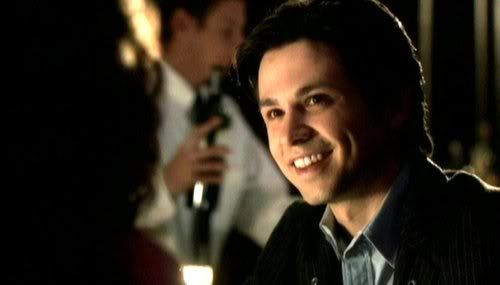
And let's not forget Rico (who kinda-sorta is one of my fave characters):


God, he's gorgeous. (He's even more gorgeous when he smiles.) I swear, when Freddie Rodríguez doesn't have a beard he is one of the cutest people ever. He was the best thing that ever happened to Ugly Betty and Grindhouse.

Though I have to say Rico lost a few cosmic bonus points when he waxed a little homophobic when David came out to him -- but then he was really nice to David and considered him family. I wonder if the show will explore that aspect of their relationship more or just leave it that...curious minds want to know.

But yeah. Lots of love for Rico - the bit about the baby episode had me close to tears a few times. He needs more screen time!